Bachelor of Science in Engineering
Mechanical or Electrical Engineering
Design your future. Engineer your impact. Build your career on a global scale.
The Bachelor of Science in Engineering at EPF is a selective and internationally oriented program designed for students who aspire to go beyond borders: academically, professionally, and personally.
Taught entirely in English and shaped by both French Grande École excellence and American academic standards, the program offers a unique educational experience combining rigorous scientific training with hands-on, project-based learning.
Through a compulsory international semester, close connections with industry, and a curriculum aligned with global accreditation standards, students develop not only strong technical expertise, but also the adaptability, creativity, and professional maturity required to succeed worldwide.
More than a degree, this program is a launchpad toward international careers, global mobility, and long-term impact in engineering and technology.
Key figures
What makes our bachelor's program unique
A selective and internationally distinctive bachelor at the intersection of French and global excellence
The Bachelor of Science in Engineering stands apart in the European landscape as a highly selective, internationally oriented program, designed to combine the strengths of leading engineering education models.
A unique positioning in Europe
While most European engineering programs rely exclusively on national or European accreditation frameworks, this degree is designed around a targeted dual international recognition strategy:
- CTI accreditation (Commission des Titres d’Ingénieur), the official quality standard for engineering education in France
- ABET accreditation (targeted), widely regarded as the global benchmark in engineering education
This dual approach ensures alignment with both the rigour and academic excellence of the French Grande École system, and the international standards expected in North America and global industry
A rare and highly selective academic model
ABET is one of the most internationally recognized specialized accreditation systems for engineering education
- Globally: ~4,800 accredited programs across 42 countries [abet.org]
- In Europe: ABET adoption is selective and strategically used for international differentiation, not as a standard accreditation pathway.
As a result very few Bachelor-level engineering programs in Europe are ABET-accredited, even fewer combine European recognition (CTI or equivalent) with ABET accreditation.
A first-of-its-kind program in France — and a rare model in Europe
This program is positioned as:
- The first Bachelor in Engineering in France aiming for dual CTI–ABET accreditation
- One of the very few program in Europe combining these two frameworks
- The only program (as designed) integrating dual accreditation ambition, full English delivery, and a compulsory semester in a university abroad.
This combination creates a unique academic offering, not currently available in France and extremely rare across Europe.
A Bachelor of excellence by design
This degree is intentionally positioned as a Bachelor of excellence, distinguished by:
- A selective international cohort
- A curriculum inspired by both French Grande École standards and Anglo-American Bachelor structures
- Strong alignment with global engineering competencies and accreditation benchmarks
- Direct exposure to US-accredited academic environments
Unlike many Bachelor programs in Europe, which are often more locally oriented or less aligned with global certification standards, this program offers a truly international academic positioning from day one.
A bridge between European and global engineering standards
By combining French academic rigour (CTI framework), US educational standards (ABET alignment), International mobility and English delivery, the program creates a bridge between two of the world’s most influential engineering education systems.
This positioning enables graduates to compete in international job markets, access top global graduate programs, or pursue professional certification pathways such as the FE/EIT route in the United States
Our positioning
This Bachelor is not simply an engineering degree — it is a strategically designed international program, offering a level of academic recognition, global alignment, and career mobility that remains exceptionally rare in Europe
A flexible global experience tailored to each student
International exposure is a cornerstone of the Bachelor of Science in Engineering. The program is designed to provide students with direct immersion in global academic environments, while maintaining a high degree of flexibility to adapt to individual ambitions and academic goals.
We believe that international mobility should be both high-quality and adaptable.
- For students: the opportunity to design a personalized and ambitious international pathway
- For parents: the reassurance of a structured, supervised, and academically validated experience
Our ambition is to offer not just mobility, but a meaningful global experience, combining academic excellence, flexibility, and international openness.
A compulsory international semester
All students complete a semester abroad during their studies, gaining first-hand experience of a different academic system and cultural environment.
This international semester allows students to engage with new pedagogical approaches, particularly in Anglo-American systems, develop strong intercultural and communication skills, and build a truly global academic and professional profile.
Whenever possible, this semester is carried out in a university accredited by ABET, reinforcing alignment with international engineering standards.
A network of high-quality partner universities
The program benefits from a growing network of international partner institutions, particularly in the United States, including:
- University of California system (e.g., Santa Barbara, San Diego)
- California State University system (e.g., Los Angeles, Santa Barbara)
- East Carolina University,
- …
These universities offer ABET-accredited engineering programs, ensuring academic continuity and high standards during the mobility period.
A flexible and personalized approach
While strong partnerships are in place, the program is built on a flexible and student-centered philosophy. Students are not limited to partner universities. They have the opportunity to propose another recognized international university of their choice to build a mobility project aligned with their academic, geographical, or professional objectives.
All options are subject to prior academic approval, ensuring the coherence of the curriculum, the quality and relevance of the selected courses, and the full recognition of credits within the program
A distinctive approach combining academic excellence and active learning
The Bachelor of Science in Engineering is delivered by a diverse and highly qualified faculty, supported by an innovative pedagogical approach designed to meet the expectations of both French Grande École standards and international engineering education models.
Students benefit from the guidance of:
- Tenure-track faculty actively involved in cutting-edge research,
- Teaching faculty actively involved in innovation and research in pedagogy,
- Faculty with international academic experience, including exposure to Anglo-American teaching methods
- Industry professionals and external experts, contributing real-world perspectives
This combination ensures a balance between scientific rigor, theoretical foundations, and practical application and industry relevance
Faculty members are closely involved in student support, ensuring accessibility, mentoring, and follow-up throughout the program.
Strong links with research and innovation
Teaching is enriched by a dynamic research environment, with faculty connected to leading research laboratories, technological platforms, and industrial collaborations.
Students are progressively introduced to research methodologies and critical thinking, technological innovation and emerging fields, and experimental and applied engineering work
This early exposure fosters curiosity, analytical skills, and the ability to engage with complex, real-world challenges.
An innovative and student-centered pedagogy
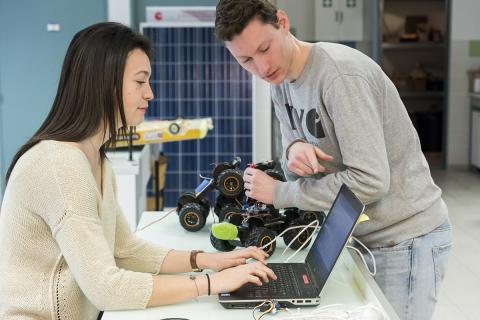
The program adopts modern teaching approaches that place students at the center of their learning experience. Students will be exposed to project-based learning (a significant share of the curriculum), hands-on laboratories and design projects, collaborative work and multidisciplinary problem-solving.
Pedagogy integrates best practices from leading international institutions, including blended and hybrid learning formats, combining in-person and digital content, active learning, flipped classroom approaches, encouraging preparation and active participation, competency-based assessment, aligned with international accreditation frameworks.
These methods support diverse learning profiles and ensure continuous progress and engagement.
Personalized support and inclusive education
A key strength of the program is its commitment to individual student success, dedicated academic follow-up and mentoring, tutoring and peer-support systems, and adapted support for students with specific needs (disability, high-level athletes, international profiles).
This inclusive approach reflects EPF’s long-standing commitment to diversity, equality of opportunity, and student well-being.
Learning connected to real-world engineering practice
Pedagogy is closely aligned with industry expectations. It includes projects and case studies inspired by real industrial challenges, contributions from partner companies and professionals, and progressive preparation for internships and employment.
Students develop a professional mindset early on, bridging the gap between academic learning and engineering practice.
Syllabus
Semester 1
Course Description: This mathematics course unit provides the essential mathematical and statistical foundations for engineering studies. Students develop skills in trigonometry, calculus, and differential equations. The course also introduces probability, statistical distributions, estimation, and hypothesis testing. These competencies support engineering analysis, modeling, quantitative problem solving, and data-driven decision-making, while preparing students for advanced engineering coursework and professional practice.
- # times this course can be taken for credit: 1
- Semester credit hours / ECTS’ credits: 10 / 12
- Grading system: ABCDF
- Mode of Delivery: Face to Face
- Language of instruction: English
Course Description: This science course unit provides the fundamental chemistry, physics, and electrical concepts needed for engineering studies. Students learn about atomic structure, chemical reactions, thermochemistry, motion, forces, and particle statics, as well as DC and AC electrical circuits. These principles support engineering problem-solving and establish a foundation for advanced engineering coursework.
- # times this course can be taken for credit: 1
- Semester credit hours / ECTS’ credits: 7 / 9
- Grading system: ABCDF
- Mode of Delivery: Face to Face
- Language of instruction: English
Course Description: This course focuses on digital engineering and develops the digital and programming skills essential for future engineers. Students gain proficiency in Microsoft Office tools as well as the fundamentals of computational thinking, algorithm design, and programming in Python. They learn to use variables, conditional structures, and loops to solve problems. These skills form the foundation for automation, data analysis, and advanced applications in digital engineering.
- Number of times this course can be taken and earn credits: 1
- Semester credit hours / ECTS Credits: 2 / 3
- Grading Scale: ABCDF
- Teaching Format: In-person
- Language of Instruction: English
Course Description: This course develops technical writing and communication skills in English, with an emphasis on clarity, structure, and adapting to different audiences. It also offers an introduction to French as a foreign language, covering the basics of vocabulary, grammar, and communication. Together, these courses strengthen technical and intercultural communication skills in an international engineering context.
- Number of times this course can be taken and earn credits: 1
- Semester credit hours / ECTS Credits: 5 / 4
- Grading Scale: ABCDF
- Teaching Format: In-person
- Language of Instruction: English
Course Description: This course provides design skills tailored to each specialization. In mechanical engineering, students develop their skills in graphic communication, CAD, technical drawing, and visualization methods. In electrical engineering and robotics, they learn the fundamentals of embedded systems, electronics, and microcontroller programming through the design of an autonomous mini-rover. Laboratory work and projects enable students to design, implement, and evaluate technical solutions specific to each field.
- Number of times this course can be taken and earn credits: 1
- Semester credit hours / ECTS Credits: 1 / 1
- Grading Scale: ABCDF
- Teaching Format: In-person
- Language of Instruction: English
Semestre 2
Course Description: This course develops the mathematical skills necessary for engineering modeling. Students study integral calculus, transcendental functions, sequences and series, as well as analytical geometry and linear algebra. The course also introduces differential equations for the analysis of dynamic systems.
- Number of times this course can be taken and earn credits: 1
- Semester credit hours / ECTS Credits: 7 / 9
- Grading Scale: ABCDF
- Teaching Format: In-person
- Language of Instruction: English
Course Description: This course introduces the fundamental principles of mechanics as applied to engineering. Students study Newton's laws, forces, motion, and oscillatory phenomena, including damping and resonance. These concepts enable students to analyze and model the behavior of physical systems in preparation for advanced studies in mechanics and engineering design.
- Number of times this course can be taken and earn credits: 1
- Semester credit hours / ECTS Credits: 4 / 4
- Grading Scale: ABCDF
- Teaching Format: In-person
- Language of Instruction: English
Course Description: This course introduces the fundamental principles of electrical and mechanical engineering through circuit analysis, statics, and strength of materials. These concepts provide the foundation for designing and evaluating engineering solutions.
- Number of times this course can be taken and earn credits: 1
- Semester credit hours / ECTS Credits: 9 / 10
- Grading Scale: ABCDF
- Teaching Format: In-person
- Language of Instruction: English
Course Description: This course develops future engineers’ communication skills, proficiency in French as a foreign language, and professional competence. Students also explore ethics, professional responsibility, sustainable development, and social responsibility in order to communicate effectively and act responsibly in an international context.
- Number of times this course can be taken and earn credits: 1
- Semester credit hours / ECTS Credits: 5 / 5
- Grading Scale: ABCDF
- Teaching Format: In-person
- Language of Instruction: English
Course Unit Description: This course unit develops applied design skills in mechanical engineering, electrical engineering, and robotics. Students explore CAD, control systems, and systems integration through hands-on projects that strengthen engineering design and problem-solving abilities.
- Number of times this course can be taken and earn credits: 1
- Semester credit hours / ECTS Credits: 2 / 2
- Grading Scale: ABCDF
- Teaching Format: In-person
- Language of Instruction: English
Course Unit Description: This course unit develops applied design skills in mechanical, electrical, and robotics engineering. Students carry out hands-on projects that enable them to design, integrate, and evaluate engineering systems while strengthening their problem-solving abilities.
- Number of times this course can be taken and earn credits: 1
- Semester credit hours / ECTS Credits: 3 / 3
- Grading Scale: ABCDF
- Teaching Format: In-person
- Language of Instruction: English
Semestre 3
Course Unit Description: This unit covers multivariable calculus (partial derivatives, multiple integrals, and vector analysis) as well as linear algebra (eigenvalues, eigenvectors, and diagonalization), with applications in engineering.
- Number of times this course can be taken and earn credits: 1
- Semester credit hours / ECTS Credits: 6 / 5
- Grading Scale: ABCDF
- Teaching Format: In-person
- Language of Instruction: English
Course Unit Description: This course introduces the fundamental principles of electromagnetism, including electric and magnetic fields, electromagnetic induction, and Maxwell's equations, which form the basis of electrical and electronic technologies.
- Number of times this course can be taken and earn credits: 1
- Semester credit hours / ECTS Credits: 4 / 4
- Grading Scale: ABCDF
- Teaching Format: In-person
- Language of Instruction: English
Course Unit Description: This course unit provides the foundations of fluid mechanics, structural mechanics, and applied scientific computing. Students learn to model and analyze engineering systems, evaluate their behavior under load, and numerically solve technical problems using algorithms and programming tools.
- Number of times this course can be taken and earn credits: 1
- Semester credit hours / ECTS Credits: 11 / 10
- Grading Scale: ABCDF
- Teaching Format: In-person
- Language of Instruction: English
Course Unit Description: This course unit strengthens professional communication skills, French as a foreign language, and preparation for professional integration. Students develop fluency in written and spoken communication, as well as the interpersonal skills expected in academic and industry environments.
- Number of times this course can be taken and earn credits: 1
- Semester credit hours / ECTS Credits: 3 / 3
- Grading Scale: ABCDF
- Teaching Format: In-person
- Language of Instruction: English
Course Unit Description: This course unit offers two specialization tracks. The Mechanical (ME) track focuses on materials science and the fundamental principles of thermodynamics applied to energy systems. The Electrical (EE) track focuses on instrumentation, control, and energy management through the development and optimization of a standalone electrical system.
- Number of times this course can be taken and earn credits: 1
- Semester credit hours / ECTS Credits: 6 / 5
- Grading Scale: ABCDF
- Teaching Format: In-person
- Language of Instruction: English
Course Unit Description: This course unit strengthens applied design skills in mechanical, electrical, and robotics engineering. Through hands-on projects, students design, integrate, and evaluate engineering systems while developing their ability to solve complex problems.
- Number of times this course can be taken and earn credits: 1
- Semester credit hours / ECTS Credits: 3 / 3
- Grading Scale: ABCDF
- Teaching Format: In-person
- Language of Instruction: English
The following courses, or equivalent, must be completed abroad at a recognized higher education institution. Preference will be given to institutions offering ABET-accredited BSME, BSEE, or BSE programs, and, where possible, to universities located in the United States. For non-partner institutions, course selection must be submitted for prior approval by an academic advisor
Semestre 4
Course Unit Description: This course unit covers the kinematics and dynamics of rigid bodies, including work, energy, impulse, and momentum in two and three dimensions, with applications to mechanical and aerospace systems.
- Number of times this course can be taken and earn credits: 1
- Semester credit hours / ECTS Credits: 3 / 6
- Grading Scale: ABCDF
- Teaching Format: In-person
- Language of Instruction: English
Course Unit Description: This course unit develops the transversal skills essential to academic and professional success. It combines professional communication and French as a foreign language with activities in sport, art, or music that foster creativity, personal expression, teamwork, and well-being.
- Number of times this course can be taken and earn credits: 1
- Semester credit hours / ECTS Credits: 6 / 11
- Grading Scale: ABCDF
- Teaching Format: In-person
- Language of Instruction: English
Course Unit Description: This course unit offers two specialization tracks. The Mechanical (ME) track focuses on materials, manufacturing processes, and machine design. The Electrical (EE) track covers control systems, electronics, and electrical machines through theoretical and experimental activities.
- Number of times this course can be taken and earn credits: 1
- Semester credit hours / ECTS Credits: 7 / 13
- Grading Scale: ABCDF
- Teaching Format: In-person
- Language of Instruction: English
Semestre 5
Course Unit Description: This course unit develops the skills needed for innovation and professional integration. It covers the fundamentals of economics and entrepreneurship applied to engineering, as well as further development of French language skills in an academic and professional context.
- Number of times this course can be taken and earn credits: 1
- Semester credit hours / ECTS Credits: 7 / 10
- Grading Scale: ABCDF
- Teaching Format: In-person
- Language of Instruction: English
Course Unit Description: This course unit offers two specialization tracks. The Mechanical (ME) track covers finite element modeling and heat transfer. The Electrical (EE) track focuses on drone systems, from flight control to autonomous navigation.
- Number of times this course can be taken and earn credits: 1
- Semester credit hours / ECTS Credits: 6 / 9
- Grading Scale: ABCDF
- Teaching Format: In-person
- Language of Instruction: English
Course Unit Description: This course unit represents
the culmination of the curriculum through a Senior Design Capstone project and a research project in either the Mechanical (ME) or Electrical (EE) track. Students draw on the knowledge they have acquired to design, develop, and evaluate an innovative engineering solution, while being introduced to research methods and technical communication.
- Number of times this course can be taken and earn credits: 1
- Semester credit hours / ECTS Credits: 6 / 11
- Grading Scale: ABCDF
- Teaching Format: In-person
- Language of Instruction: English
Semestre 6
Course Unit Description: This course unit consists of a six-month internship in a company or research laboratory. Students put their technical and professional skills into practice in a real-world environment, while developing their autonomy, analytical skills, and understanding of the challenges of engineering and innovation.
- Number of times this course can be taken and earn credits: 1
- Semester credit hours / ECTS Credits: 6 / 30
- Grading Scale: ABCDF Teaching Format: In-person
- Language of Instruction: English
Understanding the grading system, the passing criteria, and the credit system

Courses are on ABCDF grading system. The conversion between grades (A-F) to GPA is defined between grades 4.0 as follows:
| A | A- | B+ | B | B- | C+ | C | C- | D+ | D | F |
| 4.0 | 3.7 | 3.3 | 3.0 | 2.7 | 2.3 | 2.0 | 1.7 | 1.3 | 0.8 | 0.0 |
Each course is passed with a grade of D+ or higher. If you receive a lower grade, you will have the opportunity to improve it through remediation.
To successfully complete a semester, you must achieve an overall average GPA of at least 2.0. Once validated, the semester awards 30 ECTS credits.
The ECTS (European Credit Transfer and Accumulation System) is used across Europe to measure your workload and track your progress. One ECTS credit represents all the time you spend learning, including classes (lectures, labs, tutorials), personal study, projects, assignments, and exams.
A full academic year corresponds to 60 ECTS credits, or roughly 1,500 to 1,800 hours of work.
To make your results easy to understand internationally, especially for students familiar with the US system, your transcript will also include an hour-based unit system. These units reflect the time you spend in class over a full semester:
- 1 unit = 15 hour of lecture, or
- 1 unit = 45 hours of lab.
Career outcomes & Opportunities
Building pathways to global engineering careers
The Bachelor of Science in Engineering is designed to open multiple high-value pathways, whether students choose to enter the workforce directly or pursue advanced studies in top international institutions.
Strong employability in high-demand sectors
Graduates develop a solid combination of technical expertise, practical experience, and international exposure, making them highly attractive to employers.
The program directly addresses strong industry demand in key sectors such as: Energy and electrical systems, Aerospace, transportation, robotics, drones, and autonomous systems, construction and industrial engineering, Automation, electronics, and advanced manufacturing.
This alignment with industry needs ensures excellent employability prospects from graduation.
These roles offer rapid professional growth and can quickly lead to higher-responsibility engineering positions.
Through internships, projects, and networking opportunities, students gain valuable professional experience before graduation.
International career potential
Thanks to its English-taught curriculum, international environment, and ambition for double French-USA accreditation, the program prepares graduates to work in multinational companies, access international career opportunities across Europe, North America, and beyond, or evolve in global teams and multicultural environments.
The program prepares students to be eligible for the Fundamentals of Engineering (FE) exam, leading to the Engineer in Training (EIT) designation in the United States. This internationally recognized milestone demonstrates a strong mastery of core engineering fundamentals and opens a structured pathway toward professional engineering licensure through the NCEES (National Council of Examiners for Engineering and Surveying).
The compulsory semester abroad in a university further strengthens this global profile.
Pathways to further studies
Thanks to its French and USA accreditation, the Bachelor also provides a strong academic foundation for students who wish to continue their studies.
Graduates can pursue Master’s degrees (MSc) in engineering or related fields, Admission to engineering schools (Grande École programs) in France, International graduate programs, particularly in Europe or the United States.
The program’s academic rigor and international recognition ensure broad access to top-tier postgraduate opportunities.
A dual promise: employability and progression
The Bachelor of Science in Engineering is designed to offer both immediate career opportunities and long-term academic flexibility.
- For students: a clear pathway to employment, progression, and international mobility
- For parents: the reassurance of a degree that combines strong career prospects with the possibility of continued studies
Our ambition is to equip graduates not only with technical skills, but with the ability to build successful, adaptable, and international careers in engineering.
Graduates are prepared for technical and engineering-oriented positions, including:
- Assistant Engineer (Electrical or Mechanical Engineering)
- Project Engineer / Junior Design Engineer
- Industrial Process or Maintenance Engineer
- Automation or Systems Technician
- R&D Technician
- Engineering Assistant
These roles offer rapid professional growth and can quickly lead to higher-responsibility engineering positions.
The program benefits from a strong network of industrial partners, offering students concrete career opportunities and exposure to real-world projects.
Examples of companies connected to the program include:
- Airbus, Safran
- Thales (aerospace & advanced systems)
- EDF
- Enedis
- Alstom (energy and infrastructure)
- Renault
- Stellantis (automotive engineering)
- Bouygues
- Vinci
- Eiffage (construction and industrial projects)
- and more.
Through internships, projects, and networking opportunities, students gain valuable professional experience before graduation.
How to enroll in the Bachelor of Science program ?
Join a selective and internationally oriented engineering program through a clear, step-by-step application process designed to recognize both your academic strengths and your potential.
Step 1 – Submit your application
You can apply through different channels depending on your background:
French-track applicants: via Parcoursup
International applicants: via our online application portal (or Campus France where applicable)
Required documents:
High school transcripts (last two years or equivalent)
Predicted or final diploma results (Baccalauréat, IB, A-Levels, or equivalent)
CV / résumé
Motivation letter or personal statement
Proof of English proficiency (TOEFL, IELTS, TOEIC, or equivalent)
Optional (recommended):
SAT or ACT scores
Additional academic or extracurricular achievements
Step 2 – Academic and holistic review
Your application is carefully reviewed based on:
Academic performance
- Strong results in mathematics and science
- Consistency and progression
Context and background
- Your educational system and opportunities
Motivation and personal project
- Interest in engineering
- Career ambitions and engagement
We assess each candidate holistically, ensuring a fair comparison across diverse international profiles.
Step 3 – Interview (for shortlisted candidates)
If selected, you will be invited to an individual interview (online or on campus).
This is your opportunity to:
Present your motivation and ambitions
Demonstrate your communication and reasoning skills
Show your fit with an international engineering program
Step 4 – Admission decision
Final decisions are based on your overall profile, combining:
Academic results
Application materials
Interview performance
A simple, exam-free application process focused on your academic potential, motivation, and international mindset—designed to give every student a fair chance to succeed.
Standardized Tests (Optional)
Applicants may submit standardized test scores such as the SAT or ACT as part of their application. While not required, these tests can help demonstrate academic readiness and strengthen an application, especially for students from diverse educational systems.
For reference, successful applicants who choose to submit SAT/ACT scores typically fall within the following range:
- SAT: approximately 1100–1350
- ACT: approximately 22–28
We evaluate all applicants holistically and fully consider a wide range of academic qualifications equivalent to the French Baccalauréat, including:
- European diplomas (e.g., Abitur, Bachillerato, Maturità)
- International qualifications (e.g., International Baccalaureate, A-Levels)
- National high school diplomas worldwide
Students who do not submit SAT or ACT scores will not be disadvantaged.
English Proficiency
As the program is taught entirely in English, applicants must demonstrate sufficient English proficiency. This can be done through:
- Previous education fully taught in English, or
- Standardized tests such as TOEFL, IELTS, TOEIC, Duolingo English Test (DET) or other widely accessible online certifications
Typical expected levels are:
- TOEFL iBT: ~80–90
- IELTS: ~6.0–6.5
- TOEIC: ~750–850
- Duolingo English Test: ~100–115
Equivalent certifications may also be accepted. In cases where standardized tests are not readily accessible, alternative forms of assessment (such as interview evaluation or prior schooling in English) may be considered.
We are committed to an accessible and inclusive admissions process, recognizing that access to standardized testing may vary across countries. Applications are therefore reviewed holistically, with flexibility to fairly assess each candidate’s background and potential.
Tuitions Fees
We believe that a global engineering education should be high-quality, transparent, and accessible. Our tuition structure reflects the international nature of the program while ensuring clarity at every step.
Tuition fees are set on an annual basis and reflect the international scope and academic quality of the program:
- EU students: €10,000 per academic year
- Non-EU students: €12,500 per academic year
These fees cover all core teaching activities and academic support services.
Your tuition provides access to a comprehensive learning and campus experience, including:
- All courses, laboratories, and project-based learning activities
- Access to engineering facilities, platforms, and digital resources
- Academic supervision, mentoring, and career support
- Student services and international support throughout your studies
We are committed to making the program accessible to talented students from diverse backgrounds.
Financial support may include:
- Merit-based scholarships
- Need-based financial aid
- Partial tuition fee reductions
- External funding opportunities (national or international programs)
All admitted students are automatically considered for available scholarships.
To support accessibility, tuition fees can be:
- Paid in several installments
- Combined with scholarships or external funding
Our teams are available to guide students in identifying the most suitable financial solutions.
We strive to ensure that financial considerations do not become a barrier to opportunity.
Our approach emphasizes:
- Transparency: clear and comprehensive information
- Equity: support mechanisms adapted to diverse situations
- Accessibility: flexible solutions for students worldwide
In addition to tuition fees, students should plan for their monthly living expenses, including accommodation, food, transport, and personal costs.
Our teams support students in:
- Finding affordable accommodation
- Accessing student housing and financial support options
- Settling into life in France
International students admitted to the program must obtain a long-stay student visa (VLS-TS) in order to study in France.
The visa process is straightforward and follows a few key steps:
- Receive your admission offer from the school
- Prepare the required documents (passport, admission letter, proof of financial resources, etc.)
- Complete the procedure via Campus France (for eligible countries)
- Submit your visa application to the French consulate or embassy in your country
- Receive your visa and prepare your arrival in France
We recommend starting this process 2 to 3 months before the start of the academic year.
Required documents (typical)
While requirements may vary by country, applicants are generally asked to provide:
- A valid passport
- Official admission letter
- Proof of sufficient financial resources
- Proof of accommodation (or temporary booking)
- Academic documents and identification photos
Our support
Our international team is dedicated to supporting you at every stage of your journey:
- Guidance on visa procedures and required documents
- Assistance with Campus France applications
- Advice on preparing your arrival and installation in France
- Support with administrative procedures after arrival (residence validation, registration, etc.)
Preparing your arrival
Once your visa is granted, we will help you:
- Organize your arrival on campus
- Access student housing solutions
- Complete required administrative steps
- Integrate into campus life through dedicated welcome services
Finding comfortable and affordable housing is an important part of your student experience. Both Montpellier and Troyes offer a range of accommodation options adapted to international students.
- CROUS (State student housing system) residences
- Easily accessible and cost-effective
- Located close to campus
- Ideal for first-year students
- Private housing options
- Student residences and individual studios
- More accessible than in larger cities
- Wide range of price options
- Shared accommodation
- A common and economical solution
Our support
We assist students throughout the housing process by:
- Providing advice and trusted housing resources
- Supporting applications to CROUS and private residences
- Helping you prepare your arrival and installation
Choosing where to study is also about choosing a place where you feel safe, supported, and cared for. We are committed to providing every student — French and international — with a high standard of healthcare and well‑being throughout their academic journey.
All our students benefit from access to the French national healthcare system (Sécurité Sociale) — internationally recognised for its quality, accessibility, and reliability.
- A simple and free system for students
- Access to an extensive network of doctors, hospitals, and specialists
- Coverage of a significant portion of medical costs (around 70% of standard expenses)
This robust public system ensures that students can receive high-quality care quickly and efficiently, wherever they are in France.
To ensure the highest level of protection, students are supported in choosing a complementary health insurance plan (“mutuelle”).
- Covers most or all remaining healthcare costs
- Enhances protection for hospitalisation, dental, optical, and specialised care
- Affordable, student-adapted solutions
With this combined coverage, families can be reassured that students benefit from comprehensive, reliable, and financially secure access to healthcare.
Student protection extends beyond healthcare to everyday life:
- Civil liability insurance (mandatory) ensures coverage in case of accidental damage to others
- Housing insurance (mandatory for tenants) protects personal belongings and accommodation
These measures are part of a broader framework designed to provide security, responsibility, and peace of mind.
Academic success is closely linked to personal well‑being. Students are supported through:
- Accessible health services for medical advice, consultations, and preventive care
- Confidential mental health support, with counselling available when needed
- Ongoing attention to well-being, stress management, and balance
Our approach is holistic: we care not only for students’ physical health, but also for their emotional and psychological well‑being.
We understand that healthcare systems can differ from one country to another. That is why we provide:
- Clear, step-by-step guidance before and after arrival
- Support in understanding coverage, procedures, and available services
- A transparent approach built on trust, clarity, and proximity
Students are never left navigating these processes alone.
For students, this means the freedom to focus fully on their studies and personal growth.
For parents, it offers the reassurance that their child is evolving in a safe, structured, and caring environment.
Our commitment is simple: to ensure that every student benefits from the highest standards of health, protection, and well‑being — throughout their entire academic experience.
Once on campus
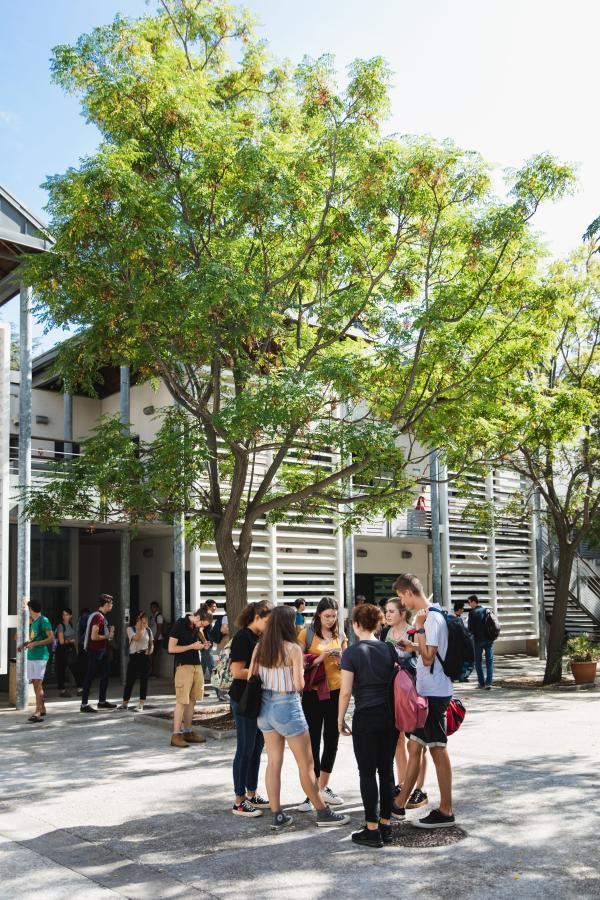
Becoming part of our institution means more than enrolling in a program — it means entering a selective, international academic community where talent, diversity, and ambition come together.
We are committed to offering every student — wherever they come from — an environment where they can integrate with confidence, feel valued, and reach their full potential.
A structured and personalised welcome
We place particular attention on the first steps of each student’s journey. Our tailored welcome ensures a smooth and reassuring transition, especially for those joining us from abroad.
- Dedicated orientation programs designed for international integration
- Individual guidance through key administrative and practical steps
- Early connections with peers, ambassadors, and academic teams
From arrival, students benefit from a high level of support and attention, allowing them to quickly find their bearings and focus on what matters most: their academic success.
An international, high-level academic environment
Our institution attracts talented students from across the globe, creating a diverse and intellectually stimulating campus.
- A balanced community of French and international students
- A culture that values excellence, openness, and intercultural dialogue
- Daily exposure to multiple perspectives, approaches, and experiences
This international dimension is fully integrated into the student experience, preparing graduates to thrive in global, complex environments.
A commitment to inclusion and equal opportunity
At EPF, inclusion is not an ambition — it is a structuring principle of the institution and a key driver of excellence.
As a pioneer in engineering education, EPF has long been committed to opening access to scientific careers to all talents, regardless of gender, origin, or background. This commitment is embodied in concrete initiatives such as ParityLab, which actively promotes gender equality in science and engineering and fosters greater diversity across all levels.
We believe that:
- Diversity strengthens innovation and collective intelligence
- Equal opportunity is essential to unlock each student’s full potential
- A respectful and inclusive environment is a condition for excellence
In practice, this translates into:
- A strong commitment to gender parity in engineering programs, supported by dedicated awareness and mentoring initiatives
- Targeted support systems ensuring that each student, whatever their background, can access, succeed, and thrive
- A campus culture built on respect, openness, and dialogue, where every student is encouraged to contribute and be heard
Through these actions, EPF creates an environment where students are not only trained to become outstanding engineers, but also to act as responsible and inclusive leaders in a global society.
A strong sense of community and belonging
Beyond academic excellence, we cultivate a campus life where students can build meaningful relationships and a strong sense of belonging.
- A dynamic student life, with associations, projects, and initiatives
- Mentoring and peer-support networks fostering integration
- Close interaction with faculty and staff, ensuring accessibility and guidance
Students are not only trained — they are accompanied, supported, and integrated into a cohesive and engaged community.
Our promise
Choosing our institution means choosing an environment where academic excellence is matched by human attention and care.
- For students: the confidence to integrate, perform, and grow
- For parents: the assurance that their child evolves in a structured, selective, and supportive environment
Our ambition is clear: to offer each student an experience that is not only academically outstanding, but also personally enriching, internationally open, and deeply supportive.
Contact